


Sublime in conversation with Marcelo di Pietro on how intellectual property empowers startups and the role of the WIPO Global Awards in creating lasting economic and cultural impact.
Meet Marcelo di Pietro, Director of the WIPO Global Awards In this exclusive interview with Sublime Magazine.
Sublime: Can you explain what the WIPO Global Awards are and what they offer to an innovative startup or SME?
Marcelo di Pietro: The WIPO Global Awards recognize startups and SMEs that use intellectual property as a strategic lever for growth and impact. They do not reward an innovation or a business model alone, but the ability to protect them and transform them into economic, social, or environmental value. For companies, this means international recognition backed by WIPO, increased visibility among investors, partners, and institutions, and access to a global network of experts. The Awards also help business leaders structure their intellectual property strategy to support long-term development.
In concrete terms, this can open the door to funding, industrial and commercial partnerships, or international expansion.
S: How do the WIPO Global Awards represent a long-term strategic journey rather than a one-off recognition?
MdP: The WIPO Global Awards are designed as a long-term acceleration pathway. While winners receive a six-month tailored mentoring program focused on IP strategy and business growth, all finalists – including the winners – gain access to ecosystem partner opportunities, year-round online fireside chats with IP experts, and exclusive networking with investors, corporates, accelerators, and innovation institutions. This combination of mentorship, expert access, and matchmaking ensures that recognition translates into sustained strategic support well beyond the ceremony.

S: What really makes the difference between a finalist and a winner: is it mainly the technological performance of the innovation, or the way the company uses intellectual property to create tangible value (economic, social, international)?
MdP: What makes the difference between a finalist and a winner is not the technology or the invention itself. We are not judging which innovation is better. What matters most is how the company has built its business around intellectual property.
A winning company is able to explain clearly what problem it is solving and why its solution matters, but above all how it protects this solution. Intellectual property shows how the time, effort, and money invested in developing an idea are secured. It explains how the business prevents copying, how it can grow internationally while keeping control of its innovation, and how these protections support concrete business decisions.
In simple terms, winners show that their IP is not just paperwork, but a strategy that helps them commercialize their solution, generate revenues, and reach more people. This is also how the business creates lasting benefits for society and the planet.
Where finalists present a strong idea, winners demonstrate that their innovation is solidly protected and already being used as a driver of growth and impact.
S: How is intellectual property reshaping access to funding and company valuation?
From the perspective of the WIPO Global Awards, we see quite often how intellectual property changes conversation with investors. Several of our winners have experienced this directly and reported that being able to clearly articulate how their innovation is protected helped build confidence. Lactips, winner in 2023, has publicly stated that the support received through the WIPO Global Awards proved highly fruitful for the deals it later secured, including a €16 million funding round and new industrial partnerships. Healinno Tech, winner in 2024, has similarly shared that rethinking IP not just as protection but as a growth and internationalization strategy helped support its expansion and a USD 5 million investment.

S: Which sectors currently benefit the most from a structured IP strategy?
MdP: Looking at the WIPO Global Awards results, the sectors that appear most frequently among applicants, finalists, and winners are Environment, Health, and ICT. These three clusters consistently represent the largest share of applications, including in 2025, and they account for the majority of finalists and winners over the past four editions. We also see strong and growing representation from Creative Industries and Agrifood, particularly in recent years.
Rather than pointing to sectors that “benefit more” from IP in general, the Awards show that companies operating in these fields are more often able to clearly demonstrate how intellectual property supports their business model, market entry, internationalization, and impact – making them stand out in the evaluation process.
S: What advice would you give to a young creator or entrepreneur who hesitates to formalize their IP?
MdP: What we consistently hear from our winners is that formalizing intellectual property early gives them confidence and clarity. Several entrepreneurs have told us that their biggest mistake was seeing IP only as protection, rather than as a strategy for growth and international expansion. Once they started thinking about IP early, it helped them structure their business, protect their efforts, and be taken seriously by partners and investors. As one winner put it, IP is not just paperwork – it is what allows an idea to travel, scale, and create impact beyond its original market. In that sense, IP is not an administrative burden, but a practical tool that helps ambition turn into something durable.
S: What would success look like for the 2026 edition at the July ceremony in Geneva?
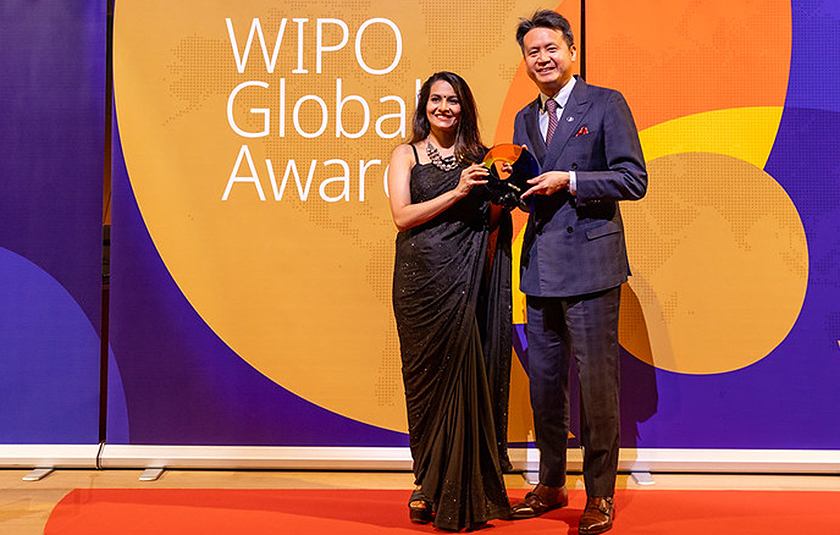
MdP: Success would be reflected in eleven companies led by inspiring leaders, able to demonstrate how intellectual property has supported their growth and international expansion. The ceremony in Geneva, held during the WIPO General Assemblies, brings together delegations from nearly 200 countries, institutions, economic decision-makers, and innovation experts. Being recognized in this setting means stepping onto the global stage.
S: What message would you like to send to entrepreneurs, creators, and designers?
MdP: Intellectual property should not be seen as paperwork, but as a passport. It allows an idea, a creation, or a design to travel, to meet partners, investors, and audiences, without losing its identity. The WIPO Global Awards show that innovation is also the art of building something that lasts.
Find out more about WIPO Awards
About WIPO
The World Intellectual Property Organization (WIPO) is the United Nations agency dedicated to serving innovators and creators worldwide, ensuring that their ideas are safely brought to market and improve lives everywhere.
We do this by providing services that help creators, innovators, and entrepreneurs protect and promote their intellectual property (IP) across borders, and by serving as a forum for exchanging ideas on cutting-edge IP issues. Our IP data and insights guide decision-makers around the world. Finally, our impact-driven projects and technical assistance ensure that IP benefits everyone, everywhere.