


When survival is not enough, the ability to walk again for Gaza’s children becomes an act of resistance.
This article is part three of WHAT ENDURES: Land, Life and Repair in Palestine, a Sublime three-part editorial series exploring land, environmental justice and repair. Part 1 – Part 2
Part 3 – To Walk Again: Repair, dignity and the future being built for Gaza’s children
Dimple Agarwal, who today works across many global humanitarian initiatives, always discusses Gaza with care. Not only because the political and on-the-ground realities are fragile, but also because she deliberately focuses on what can be done, even in circumstances that feel overwhelming.
“Hopeful and humbled. From the land of zatter and olives. Where the best of humanity survives. Where courage and dignity thrive.”
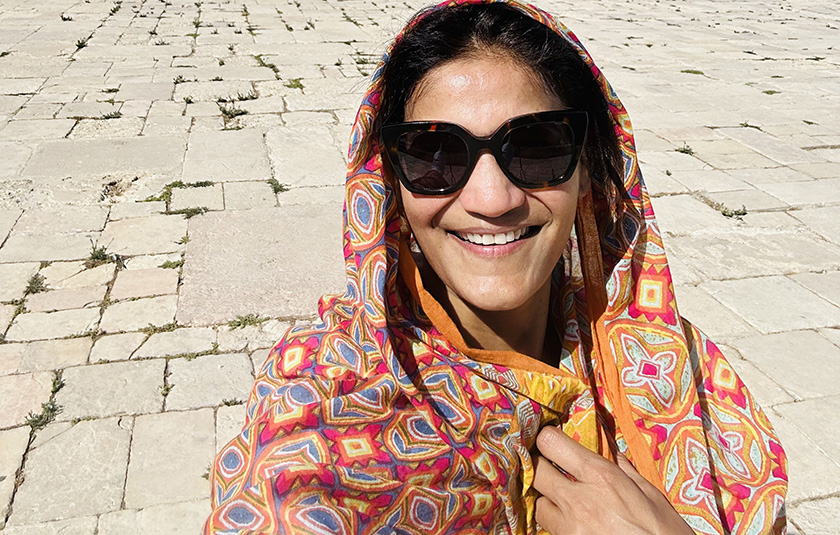
For her, that place is mobility, the ability to move through the world with independence and confidence, and the profound shift that occurs when a child is able to walk again.
Across Gaza, thousands of children are living with limb loss after catastrophic injuries caused by repeated military assaults, leaving it with the highest number of child amputees per capita in the world.
Many Palestinian children have lived through injuries that should not have been survivable, and what happens next, Dimple believes, matters as much as what they have already endured.
For a child, mobility is not abstract. It is the freedom to attend school, to play, to fetch water and to move without constant assistance.
Despite prosthetics being foundational for children – they shape not only physical capability but confidence and participation – unfortunately, in some healthcare systems, artificial limbs are treated as specialised or optional.
Access remains the central challenge, as prosthetic limbs are often prohibitively expensive and slow to deliver, particularly in contexts shaped by conflict and restriction.
Low-cost prosthetic camps
Jaipur Foot, the world’s largest provider of low-cost prosthetics, is based in Rajasthan’s ‘Pink City’, a popular stop on India’s famous Golden Triangle visitor route.
It was established by Mr. DR Mehta, who himself understands the importance of mobility. Back in the 1970s, he was involved in a life-threatening road accident that crushed one of his legs. Ultimately, his limb was saved by doctors, but it inspired in him a desire to provide artificial limbs to lower-income individuals. In the past five decades, this humble yet revolutionary NGO has fitted more than 2.5 million people across Asia, Africa and the Middle East.
A Jaipur Foot prosthetic costs as little as $40–50 in India and around $300 in international camps, where staff, equipment and materials must be transported for fittings. Even at that higher cost, it remains a fraction of the price in Europe, where a prosthetic can cost upwards of $10,000.
This difference makes scale possible in ways conventional healthcare models often cannot, particularly in conflict settings. The organisation prioritises access over perfection, designing limbs that are robust, adaptable and suited to everyday life.
Dimple’s connection to Jaipur Foot is personal, rooted in her childhood ties to Jaipur and familiarity with its work. She is now working to support future prosthetic camps for children affected by conflict, hopefully in partnership with organisations such as HEAL Palestine.
Given restrictions on access to Gaza, early planning focuses on regional camps in locations such as Cairo or Amman, where children could be temporarily supported, fitted with limbs and receive follow-up care.
Dimple is careful not to frame this work through the language of charity. For her, it is about removing barriers and restoring agency, allowing children to reclaim movement and families to regain balance.
“Restoring mobility is not about fixing bodies, it is about reopening futures.”
Walking is not the end goal, but the beginning. It marks the moment when imagination becomes possible again.
Throughout her time in the West Bank, one thing became clear to Dimple: everyone had a story. A son arrested. A father lost. A road that blocked children on their way to school. Land confiscated. A future suspended.
“Statistics dehumanise,” she observes. “Even one child killed, one limb lost – that’s already too many. Palestinians don’t want pity. They want us to listen. To share their stories. To put pressure on complicit governments.”
For Dimple, restoring mobility is not only about helping children return to school or play again, vital though that is. It is about ensuring they can grow as participants rather than spectators – able to move across their own landscape, to care for it, to tend it, and one day to protect it.
To walk again, she believes, is to step back into life and, in doing so, to reclaim the possibility that these children may one day become custodians of this ancient land, carrying it forward.
Continue reading Dimple’s firsthand experience of volunteering in the West Bank.
WHAT ENDURES: SUBLIME EDITORIAL SERIES | LAND, LIFE AND REPAIR IN PALESTINE
Part 1 – Rooted in Resilience: Sustainability, survival and daily life in the West Bank
Part 2 – The Land Remembers: Seeds, soil and the work of preservation.
Part 3 – To Walk Again: Repair, dignity and the future being built for Gaza’s children
This editorial series, by Sublime journalist Jen Marsden, “What Endures: Land, Life and Repair in Palestine,” draws on the firsthand experiences of Dimple Agarwal and explores themes of sustainability, land stewardship, environmental justice and repair. It is part of Sublime’s commitment to highlighting stories that matter and illuminating practices of resilience, care and continuity in challenging contexts. The perspectives shared here reflect personal engagement and observation and aim to inspire reflection on the connections between land, community and sustainable action.For more information about the series or collaborations contact: victoria@sublimemagazine.com