


High in the ancient Western Ghats of India, a poured-earth mountain retreat redefines slow living through coffee, constellations and unhurried immersion. Sublime’s Jen Marsden visits Varenya.
“See the top of that mountain? That’s where we’re heading.” I joke to my companion as we leave the bustling hill station of Chikmagalur behind. Turns out, the joke’s on me.
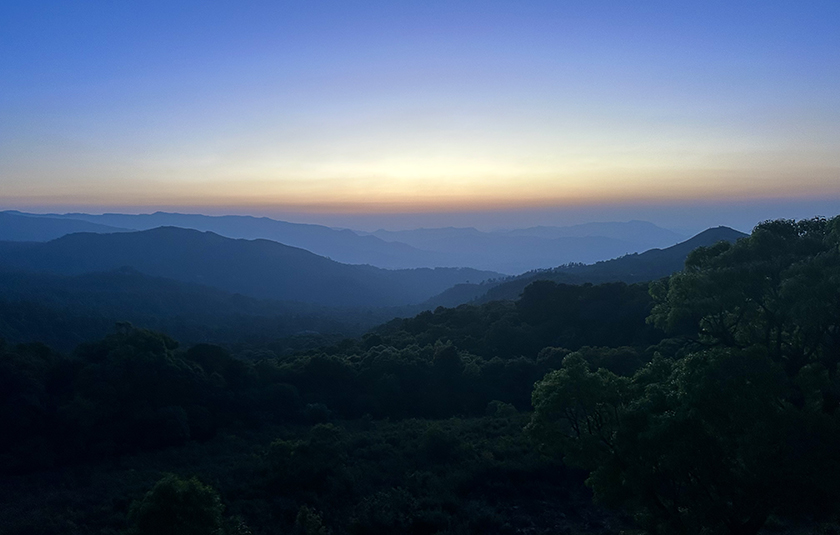
In the hush of late afternoon, we begin the long, winding ascent through the Western Ghats, where forest shade dapples our skin with dancing sunlight and the air grows cooler and cleaner. The bumpy road coils steadily upward, red dust lifting behind us in powdery clouds, coffee slopes unfurling on either side. Each turn reveals another ridge with jaw-dropping views until, finally, at the summit, I catch my first glimpse of our home for the next couple of nights.
Varenya.
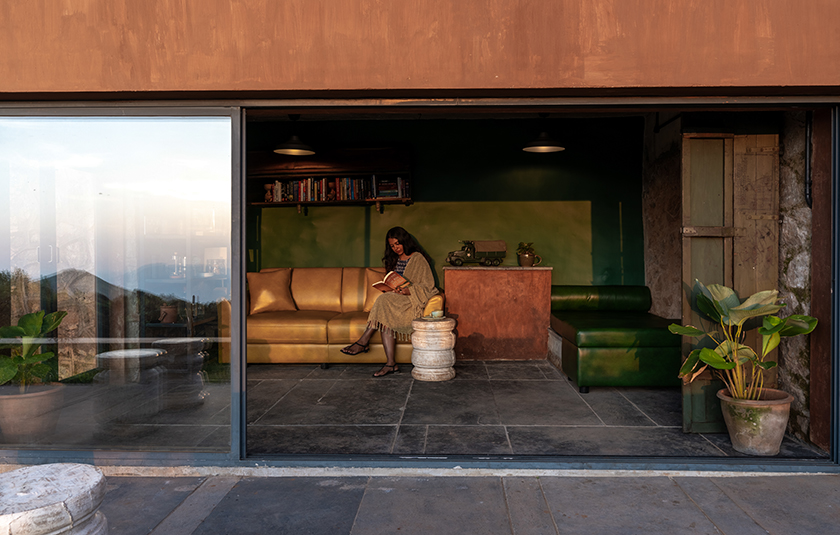
The expansive property stands poised against seven receding layers of peaks, glowing in the low amber light. It does not appear placed upon the hillside, but rooted within it.
And yet, for all its harmony with the landscape, Varenya’s presence is an impressive feat. Built over two years, the villa holds itself confidently along the steep gradient of the hillside. One cannot help but imagine the labour and patience required to coax architecture into such terrain. The retaining wall, rather than concealed, has been celebrated. Draped in budding green foliage, it forms a living spine that anchors the house to the earth – an engineering necessity transformed into quiet beauty.
This land is said to be more than 50 million years older than India’s mighty Himalayas. You feel that antiquity in the soil, iron-rich and deep red, and in the softened silhouettes of the mountains themselves. Not dominating, but enduring.
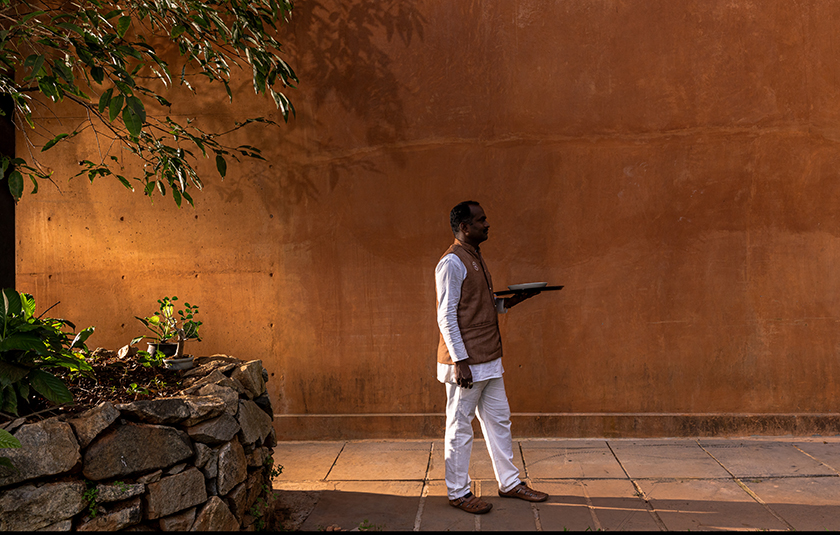
Our host, Deepanker – “Just call me Deep,” he insists – waits at the gate with his beaming team, who offer us cold towels, followed promptly by chukku coffee, a local spiced coffee, and a tray of nutritious snacks.
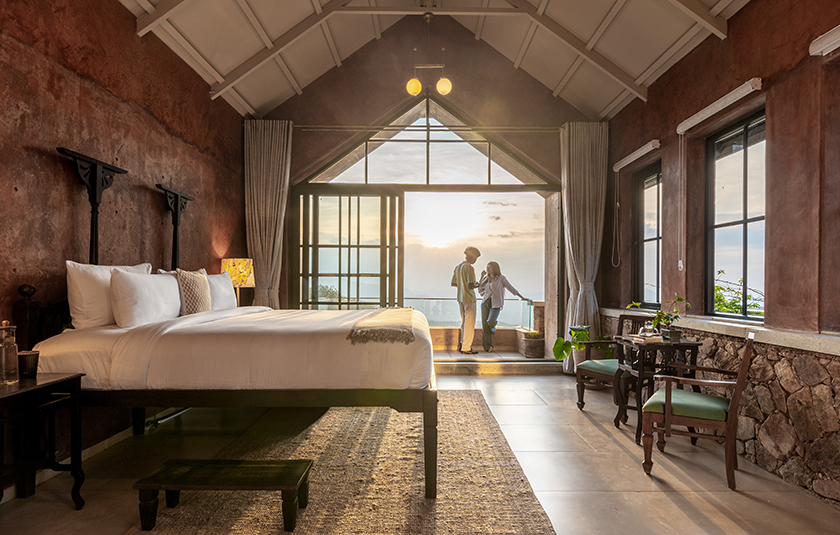
Inside, the house feels tactile and grounding, its curated décor thoughtfully considered. Poured-earth walls in deep red tones and exposed local stone. Leather-polished, cool Kota stone underfoot. Reclaimed colonial chests and wardrobes. Vintage teak ceiling fans and brass-and-glass sconces. A grand four-poster complete with small wooden step for a literal climb into bed. Natural linens that catch the breeze. A small transistor radio resting on a shelf, as if someone had just left it there decades ago.
There is no air conditioning, and you neither miss nor need it. The architecture breathes.
And then there are the views. In my suite, three walls are floor-to-ceiling panoramic windows, opening onto sprawling terrace balconies, where bougainvillaea spill in hues of orange, pink and white. Perched so high and secluded above the rest of the world, there is no need to draw the curtains. Instead, I let the mesmerising sunrises stream in each morning, and vibrant dusky hues flood the space by night.
In the decadent bathroom, with its traditional Chettinad lime-and-egg plastered walls, there is further grandeur. An outdoor bathtub. A panoramic shower. A small skylight directly above the towel rail allows the sun to warm towels naturally. It feels like architecture guided by intuition rather than excess.
In the main living space, we are ushered to a table and served the first of many memorable meals. Flavourful egg masala, aloo methi, crispy bhindi (okra) and paneer butter masala, rotis and chaas (spiced buttermilk), all presented on a brass-plated thali. Happily satiated, head chef Yasin and Zeba from the young kitchen team join us to discuss meal preferences for the coming days. They speak enthusiastically about native dishes and ingredients plucked fresh from their kitchen garden.
Mountain nights are crisp as the sky deepens into twinkling velvet. By nightfall, the temperature drops quickly at 1,500 metres. Our first evening is spent beside a crackling bonfire under an unpolluted sky. My tastebuds tingle with a barbecue dinner of tandoori ananas (pineapple), smoky and sweet, caramelised tandoor sweet potatoes, and warming corn shorba.
Between courses, while sipping a gin and tonic, Deep traces the constellations overhead for us, moving effortlessly from forest tales to stories of the sky. It feels intimate, human, primaeval.
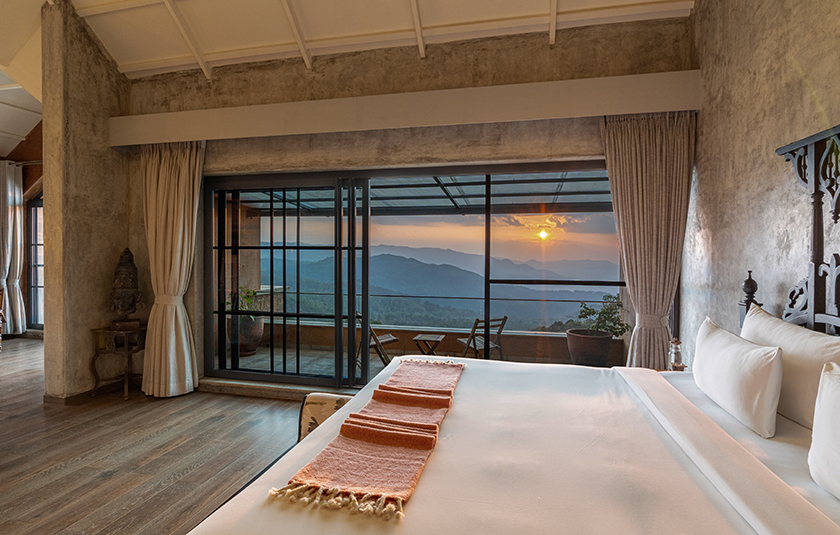 Later, slipping into bed, I discover a hot water bottle already tucked beneath the sheets. A deeply comforting gesture. There is no formal turndown service, and yet each time I step out, I return to find things gently tended. Mugs cleared. Towels refreshed. One evening, soaked almonds beside my bed. Another, a natural oil diffuser lit quietly in the corner, scenting the space with something resinous and elemental. It feels less like service and more like…care.
One bright afternoon, I step into my suite to find an elderly bonnet macaque near the fountain beside my outdoor bathtub. Slightly limp, separated from his troop, and entirely unapologetic, he leans forward to drink, water dribbling from his mouth. For a suspended moment, we regard one another in our shared territory.
Wildlife isn’t something you go looking for here. It arrives.
The following morning, on our first walk together, Deep points out scratches on bark and speaks quietly of pug marks from a tiger that remains elusive. Small signs that most of us would overlook.
A former advertising executive, Deep left the rat race to become a naturalist and has since spent decades in Central India’s most revered national parks. He carries a quiet authority shaped by years of watching forests awaken and sleep. He notices everything.
He speaks of leopard cats moving silently through the undergrowth and shows me footage from the property’s camera trap, which recently captured a jungle cat with markings so intricate they look painted.
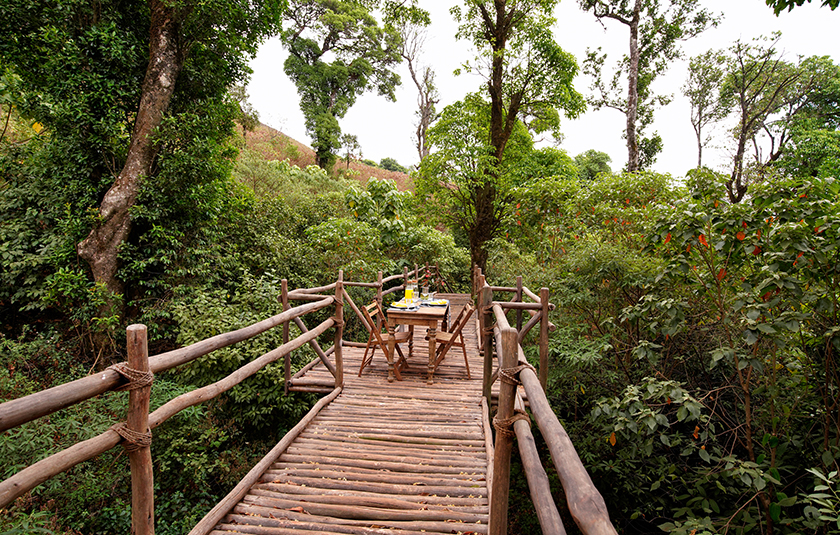
He crouches beside a delicate funnel-shaped web stretched between moss-covered stone, pointing out the spider’s precision. Later, beneath the coffee shrubs, he shows me civet droppings – the inspiration behind Indonesia’s kopi luwak culture.
Nothing here exists in isolation. Everything feeds into something else.
Coffee is serious business in this region, its ritual punctuating each day. We taste it at breakfast and again during high tea on the sweeping terrace – brewed from beans grown on these very slopes, served with earthy-toasted makhana (lotus seeds) and Jhalmuri, the nostalgic Kolkata snack of puffed rice tossed with spice and crunch. Simple, textural food that pairs perfectly with mountain air and unhurried conversation.
Usually planted between 1,000 and 1,300 metres, at 1,400 metres and above, Deep explains, the flavour of coffee becomes more complex. Arabica adapts, its slower growth developing greater nuance.
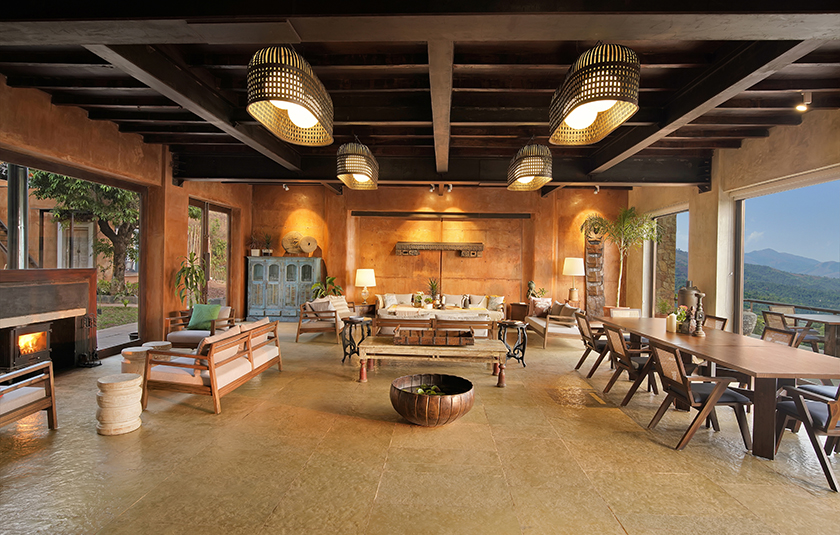
Deep speaks too of what he hopes Varenya will become. Small retreats. Yoga gatherings. Writing residencies. Art immersions. Spaces where people can come to create, to think, to listen. It makes sense. The mountain already carries that energy.
Crag martins skim the sky and build dome-shaped nests beneath the eaves, adding their own mud architecture to the story of earth meeting shelter.
Later that day, we take an adventurous jeep ride to a secluded waterfall and plunge into water cold enough to shock every sense awake. It’s followed by a South Indian picnic lunch of beetroot and moong dal salad, steaming amla (gooseberry) rasam, aloo, rice roti and brinjal (aubergine) masala, served with the freshest buttermilk I have ever tasted.
By our final evening, I feel folded into Varenya’s rhythm. The gentle rise and fall of mountain light.
Dinner leans continental that night. Light, crisp Parmesan cheese balls. Cucumber, yoghurt and dill cooling the palate. Paneer shashlik with sautéed vegetables in garlic sauce, served with herbed rice. Tres leches so soft that it dissolves almost instantly.
Despite the feasting, stargazing, and Ayurvedic massages in the beautifully equipped spa, nothing about Varenya feels excessive but rather considered.
As we descend the mountain road, red dust rising once more behind us, I realise something within me has subtly shifted.
Varenya holds space. And in slowing you down, it holds you too.