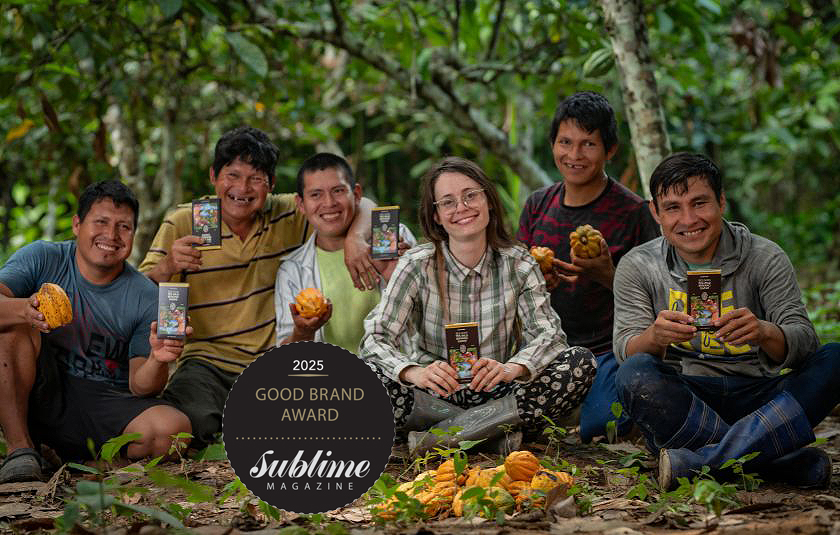
Born deep in the Bolivian Amazon, among the mystical “cacao forest islands” or Chocolatales, the story of Kindred Forest unfolds. We spoke with the founders about the brand’s values and how, through close collaboration with local communities, every chocolate bar becomes a powerful act against deforestation
Sublime: Can you share the story of how Kindred Forest began?
Ben & Katya: We are Ben and Katya, and we both used to work in the corporate sector. After the pandemic, we were  looking to start something of our own that we were both passionate about and that something for both of us is nature, and especially the forests. The idea of Kindred Forest was born during our trip across Latin America and the Amazon rainforest where we stayed with various indigenous communities and discovered the potential for sustainable forest products as a way of fighting deforestation and funding conservation.
S: What is the core ethos of your brand?
B & K: Our core ethos is working directly with forest communities to preserve rainforest biodiversity and the cultures that protect it. We believe there is a strong link between indigenous cultures and nature preservation, as many of these people have lived in these environments for generations and they know best how to care for it and how to preserve it. It’s fundamental in our view that we support these people to do the right thing rather than come up with ideas of our own and dictate the solutions. A major driver behind deforestation is industrial agriculture.
We want to help communities resist monoculture and other destructive commercial activities by supporting sustainable wild-harvesting and cultivation methods in harmony with biodiversity. The values we are guided by in our work are:
- Direct trade: We cut out intermediaries to ensure the most value stays with farmers and harvesters, and we develop close and long-term relationships with them.
- Transparency: We are open about every aspect of our supply chain and everything else we do.
- Traceability: We show the exact locations our products are sourced from and the individuals and cooperatives that we work with.

S: Could you sum up your organisation’s main purpose?
B & K: Our broader purpose and vision is the regeneration of the world’s rainforests and their associated biodiversity by promoting regenerative agroforestry practices founded in indigenous wisdom as an alternative to monoculture and deforestation. This directly benefits local communities as we link them with Western markets. Importantly, we offer more sustainable choices to consumers and businesses, showing them the direct positive impact on communities and nature.
S: How does being part of the Wildlife Friendly network influence your work?
B & K: Being part of the Wildlife Friendly® Enterprise Network strengthens our work in three key ways: sourcing, credibility, and partnerships.
On the sourcing side, it connects us to conservation-driven initiatives like Little Fireface Project in West Java, born out of Anna Nekaris OBE’s work in studying and protecting slow lorises and Swara Owa Foundation in Central Java, where farmers and conservationists collaborate to safeguard Javan gibbons and restore critical habitats. By offering Wildlife Friendly® certified products, we ensure that every cup supports biodiversity, forest protection, and local livelihoods.
The certification itself adds credibility and trust. Wildlife Friendly® reflects the highest standards of biodiversity conservation, animal welfare, and community empowerment, giving our customers confidence that their choices truly make a difference.
Finally, membership in the network deepens our partnerships. It aligns perfectly with our vision to preserve and regenerate rainforest biodiversity and helps amplify our impact by promoting wildlife-friendly practices to a wider audience. As we expand our portfolio of certified products, we aim to grow demand for biodiversity-preserving trade while strengthening the communities and ecosystems at its heart.

S: Could you walk us through the journey of your Wild Beniano cacao bar?
B & K: It’s a long and fascinating story… It began three years ago, almost by accident. We were travelling through Santa Cruz in Bolivia where we came across a little chocolate shop of a local chocolate brand called Chocolate Baure. Since we were interested in unusual wild ingredients we decided to investigate. We enquired about the origin and found out about this special place in the Bolivian Amazon and how to get there. We travelled hundreds of miles across flooded roads to Baures and met with local families who showed us the magical “cacao forest islands” or Chocolatales as they are locally known.
We were fascinated by this intriguing landscape – this part of the Amazon is more like a swamp than a rainforest, with lush cacao forests springing up from the marsh fields like islands, true miracles of nature! And on top of this, we saw these ancient earthworks running through the Chocolatales, which used to be treated as canals by an ancient indigenous civilisation that inhabited this rainforest centuries ago and likely propagated this native cacao.
We ended up coming back in a few months to stay with the local families and learn about this cacao from them. We had decided to purchase and ship a small batch of processed cacao beans to the UK to turn into chocolate. On the way to Baures, we had also listened to Obsessions: Wild Chocolate Podcast series by Kaleidoscope, where we first heard about Volker Lehmann, the pioneer of this cacao, and learned about his incredible story. We bumped into him in Baures at a most critical time as we were struggling with the logistical challenges of getting the beans dried to export levels (of 6% moisture content) and getting them from rural Bolivia to the UK. He came to the rescue and we ended up working together since then.
After the beans arrived in the UK we approached Mike and Becca of Chocolarder, a Cornish craft chocolate maker who had previously worked with the Ashaninka Amazonian beans. They transformed the beans into chocolate for us and made all the vibrant flavours of this cacao come into life.

S: What does “rainforest-friendly” mean to you in practice?
B & K: Rainforest-friendly means that the product is in some way supporting rainforest conservation. It means that it is sustainably grown in regenerative agroforestry systems or responsibly harvested from the wild. There is a rainforest alliance certification scheme and many others, but we strive to go beyond these frameworks. For example, in Indonesia we partner with scientists who study agroforestry systems to ensure there is a positive impact on endangered species as well as the local livelihoods. We also strongly believe in the value of wild harvesting as a way of incentivising rainforest protection. Why replace forests with agriculture when forests already produce an abundance of world-class ingredients that we all need?
S: How do you ensure profits support conservation and Indigenous communities?
B & K: We exclusively source products from community-based projects and directly from farmers and farming cooperatives dedicated to preserving natural rainforest environments, integrating biodiversity conservation into their cultivation and/or wild-harvesting practices. We employ a rigorous selection process to ensure that projects demonstrate a positive impact on nature, utilising traditional local and indigenous knowledge alongside modern scientific research.
B & K: All of our projects and collaborations are impactful and they are all different depending on the regional context. Perhaps, we should especially emphasise our work with the Little Fireface Project led by the world-renowned primatologist Anna Nekaris OBE. This project is a great example of the collaboration between the farming communities and researchers, where indigenous knowledge gets supported and combined with science to help protect the critically endangered slow loris while supporting local livelihoods.
We are also excited about the strong relationship we have built with Masarang, a not-for-profit organisation in North Sulawesi, Indonesia, whose carbon neutral and waste-free factory is powered by geothermal energy. They make the magical arenga forest sugar there that we are now introducing to the UK.
S: What challenges did you face when launching Kindred Forest?
B & K: One of the key challenges was the logistics given the remote location of the wild cacao forests and the high costs associated with it. This was not something either of us had any experience in at the time, although it’s fair to say we have plenty now! Another challenge is communication and marketing – consumers are tired of green-washing and are generally suspicious. They also look for something new. We have this incredible story to tell and treasures to share from the world’s forests, but how do we reach all these different audiences in a way that cuts through the noise?

S: Could you tell us about your plans in terms of products and markets?
B & K: Within the next few months, we are adding quite a few new exotic coffees from Cauca in Colombia as well as Andean Bear-Friendly certified coffee. We are also looking to expand our chocolate and cacao product portfolio to include the cacao from various regions of Colombia. We should also mention that soon we will be releasing a dark milk vegan chocolate bar that uses both our arenga sugar and wild Beniano beans developed in collaboration with Solkiki craft chocolate maker. Solkiki developed the recipe earlier this year and won Gold medals at the International Chocolate Awards across several different categories.
S: And finally, which product are you most proud of and why?
B & K: Our wild Beniano chocolate bar which recently won two Great Taste stars and was also nominated for the Golden Fork award as one of the three Outstanding Bursary winners this year. This is an incredible achievement given this is our first ever product. Its incredible complex flavour, its wild origin, the heirloom genetics, the adventurous story of its creation and the wider context of wild chocolate islands and how this cacao became famous through Volker’s efforts – it just has so much going for it that it is one of the most special and unique chocolate bars out there.