


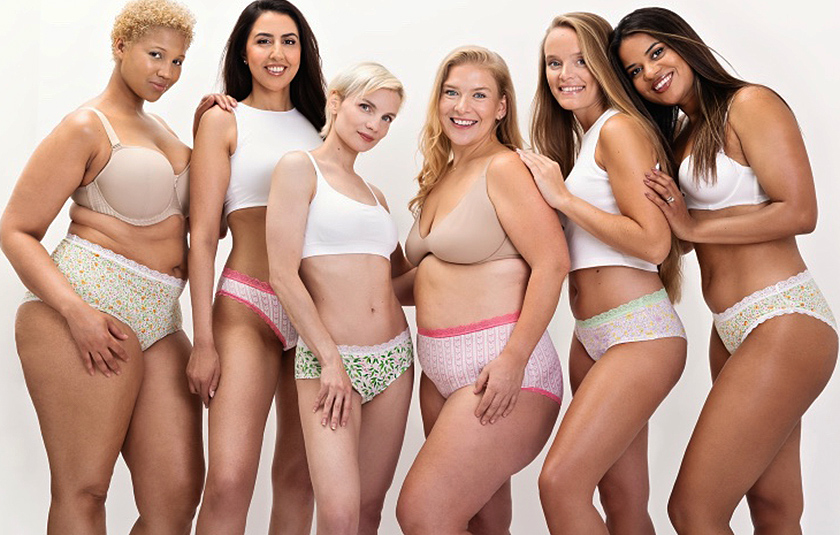
Meet Bumboo, a science-led underwear brand asking different questions about materials, fit and everyday comfort
The brand’s story begins not in fashion, but in curiosity. Elizabeth Hadley came to lingerie through a way of thinking shaped by science: one that questions assumptions, tests materials, and looks closely at how things actually work.

During the Covid lockdowns, that curiosity took a practical turn. Sewing became Elizabeth’s creative way to explore form, structure and problem-solving, not as fashion, but as a way of construction. She immersed herself in drafting patterns, experimenting with fabrics and discovering the elegance of constructing three-dimensional garments.
“It played to my mathematical brainset,” she later reflected. “The geometry, the engineering, the creativity. It all clicked.”
Her hobby quickly grew, ultimately landing her at the final stage auditions for the Great British Sewing Bee 2025 (a BBC TV programme where amateur sewers compete in weekly challenges to be crowned Britain’s best home sewer), an experience that validated her growing talent.

What began as experimentation soon exposed deeper tensions between comfort and convention, and between what the industry offers and what bodies actually need.
As her understanding deepened, so did her awareness of the compromises the lingerie industry has quietly normalised environmentally, materially and physically. Synthetic fibres shed microplastics with every wash. Cotton, often assumed to be benign, remains one of the most water-intensive crops in global agriculture.
It was at that point that stars began to align and Elizabeth’s scientific curiosity led her to explore the new, potential biotechnological solutions that could meet the problem. The turning point came through material science. Advances in lyocell processing, combined with bamboo’s potential as a rapidly renewable raw material, offered a different logic, one rooted in performance as much as impact. Her textile curiosity, scientific expertise and personal awareness of non-inclusive underwear merged into a powerful realisation: she had an opportunity to challenge an industry problem.

From there, Bumboo was born, an idea grounded in sustainability, science-backed innovation and joyful self-expression. Working alongside Innovate UK and UKFT (UK’s network for fashion and textiles), Elizabeth began to build the brand weaving together biotechnology and fashion industry’s sustainability movement.
Rethinking the base layers
The lingerie industry, for all its beauty, has long been defined by environmentally intensive materials. Cotton, often perceived as “natural” and therefore eco-friendly, is one of the most water-hungry crops on the planet. Synthetic alternatives like nylon and polyester are derived from fossil fuels and shed microplastics with every wash. These fibres, once a symbol of modernity, now represent a profound environmental burden.
In recent years, new bio-based fabrics have emerged as hopeful solutions. Tencel, made primarily from wood and processed using the lyocell method, has gained widespread recognition for both its softness and its significantly lower environmental impact compared to cotton or synthetics.
Rather than relying on slow-growing timber, the brand works with bamboo, a fast-growing plant that regenerates with minimal water and no need for pesticides or fertilisers. When processed through the lyocell technique, the result is bamboo lyocell, a material that offers the same sustainability benefits as Tencel, with an even more regenerative resource at its core. In the lingerie market, this represents a bold step forward: a fibre that is both technically superior and environmentally responsible.

Bamboo lyocell sits at the heart of Bumboo’s approach, not as a headline claim, but as a material chosen for how it behaves: against skin, in wash cycles and within production systems. For example, bamboo is a renewable raw material that grows at rapid rates without agricultural strain. Additionally, the lyocell closed-loop production reduces any chemical discharge into the environment.
For people, the benefits are equally compelling. Bamboo lyocell is exceptionally soft and often compared to silk, yet far more durable. It is breathable, moisture-wicking, thermoregulating and naturally hypoallergenic, making it an ideal choice for sensitive skin.
Stretch presented another challenge. Conventional elastane has long been treated as indispensable in lingerie, despite its petrochemical origins. Bumboo replaces it with a bio-based alternative, quietly questioning that assumption. While material innovation is central to the Bumboo, the brand’s design philosophy is just as distinctive. Design choices resist a familiar sustainability trope. Colour and playfulness are not treated as indulgence, but as part of what makes responsible design liveable.
Inclusivity is approached as a design condition rather than an extension. Cuts and sizing are developed to account for variation, acknowledging that sustainability rings hollow when bodies are excluded. Durability is treated as a form of quiet intervention. By resisting premature thinning and loss of shape, the garments reduce replacement cycles, without asking the wearer to change their behaviour.
Sustainability beyond fabric
Beyond the garments, the same questions about consequence guide every choice. Packaging avoids plastics in favour of recyclable bamboo paper. Fabric waste is kept intentionally low, a small but telling shift in an industry accustomed to excess. These decisions aren’t listed as badges of honour; they are expressions of attention: less noise, fewer hidden costs.

Behind the scenes, the brand’s choices reflect a consistent logic: design with attention to human and ecological systems, not just optics. Production partnerships are selected with care, not claims; and the business model – light on retail spectacle and deliberate online in presence – treats impact as a practice, not a promotional line.
“Sustainability here isn’t a secondary badge; it’s a logic that stitches through decisions.”
Looking ahead, Bumboo’s ambitions are less about expansion for its own sake and more about exploration. New styles and material inquiries are underway, shaped by questions the brand continues to ask rather than by an imperative to scale. Engagement with community-centred events and educational partnerships signal a shift toward shared inquiry, not broadcasted achievement.
In an industry often divided between aesthetics and ethics, Bumboo offers a considered experiment. One that starts with material intelligence, listens closely to bodies, and treats innovation as a responsibility rather than a performance. It shows that scientific innovation can be beautiful, that comfort can be conscious and that fashion can support both people and the planet.
bumboolingerie.com follow on instagram @bumboo_lingerie
Bumboo Lingerie has received the Sublime Good Brand Award 2025 in the Fashion & Style category, honouring its dedication to sustainability, conscious production and innovation.


